
Exercise after 40 for brain health can sound like another task competing for a place in an already full day. There are seasons when movement gets whatever is left: a ten-minute walk between meetings, a weekend bike ride, or a promise to “get back into it” after life settles down.
A new study offers a reason not to dismiss those midlife choices—but it also deserves more care than a dramatic headline can provide.
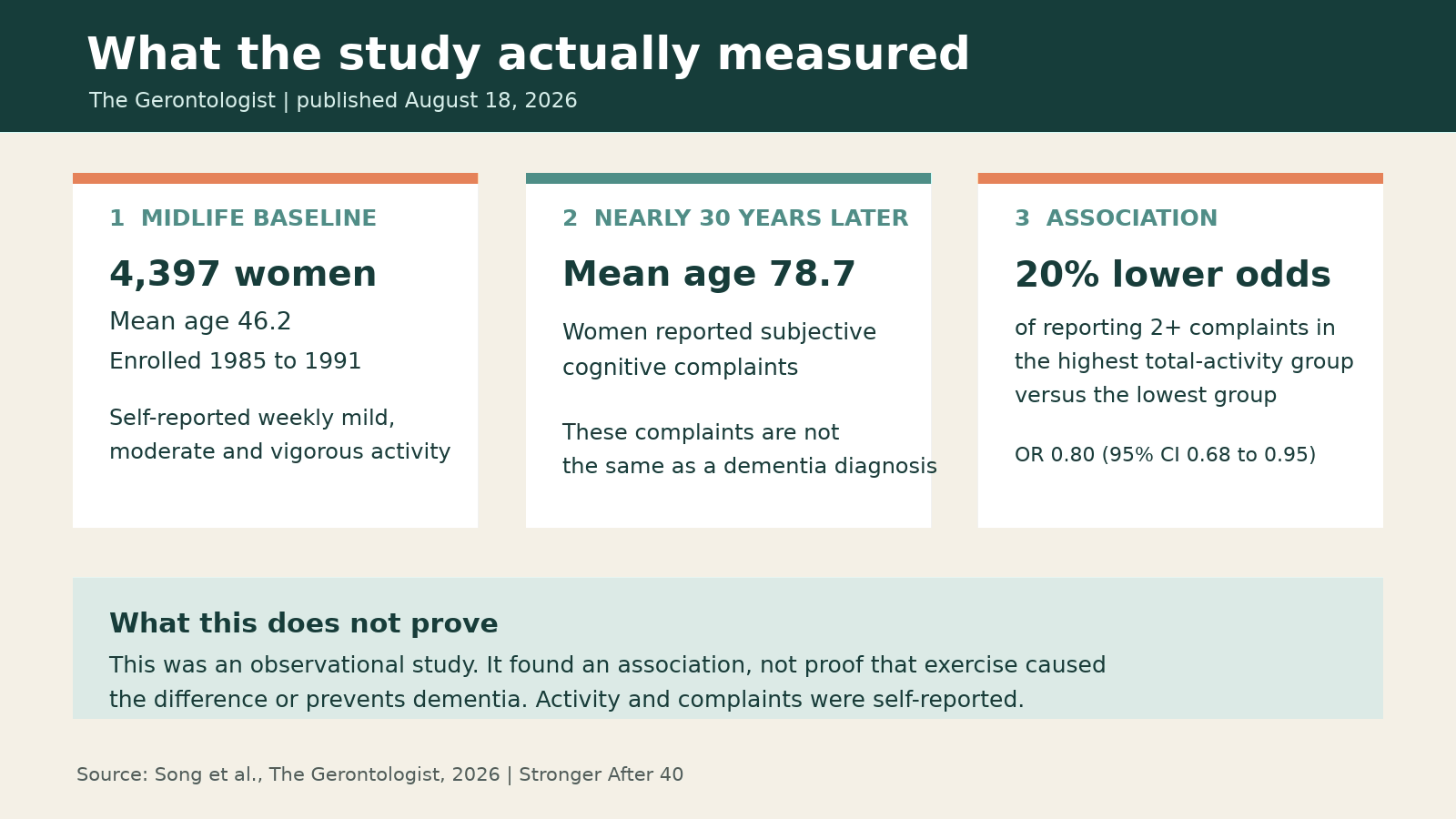
Researchers followed 4,397 women for nearly three decades. Women who reported the most physical activity in midlife had lower odds of reporting multiple cognitive complaints in later life than women who reported the least activity. The finding is encouraging. It is not proof that exercise prevents dementia, Alzheimer’s disease or cognitive decline.
Here is what the research can tell us, what it cannot, and how to turn the useful part into a realistic movement plan after 40.
Exercise after 40 for brain health: what did the 30-year study examine?
The study, published online in The Gerontologist on August 18, 2026, used data from the New York University Women’s Health Study.
At enrollment between 1985 and 1991, participants were 46.2 years old on average. They reported how much mild, moderate and vigorous physical activity they had done during the previous year. Researchers converted those reports into a weekly activity measure and divided the women into three groups, from lowest to highest activity.
Nearly 30 years later, at an average age of 78.7, the women completed the Cognitive Change Index, a questionnaire about subjective cognitive complaints.
| Study detail | What researchers reported |
|---|---|
| Participants | 4,397 women |
| Average age at enrollment | 46.2 years |
| Midlife measurement | Self-reported mild, moderate and vigorous activity during the prior year |
| Follow-up | Nearly 30 years later |
| Average age at follow-up | 78.7 years |
| Outcome | Two or more subjective cognitive complaints measured with the Cognitive Change Index |
| Main result | Highest total-activity group had 20% lower odds than the lowest group |
Subjective cognitive complaints are a person’s perception that some aspect of thinking has changed. They are worth studying, but they are not the same as a diagnosis of dementia and are not an objective cognitive test.
What does “20% lower odds” mean?
Women in the highest third for total midlife activity had 20% lower odds of reporting at least two late-life cognitive complaints than women in the lowest third. The reported odds ratio was 0.80, with a 95% confidence interval of 0.68 to 0.95.
That wording matters.
“Lower odds” is not the same as saying that 20 fewer women out of every 100 experienced complaints. The study abstract does not provide the absolute percentages needed to make that translation. It also does not tell an individual woman what will happen to her.
The safest interpretation is this:
In this group of women, higher self-reported physical activity in midlife was associated with fewer subjective cognitive complaints nearly 30 years later.
That is interesting evidence. It is not a guarantee, a prescription or proof of cause and effect.
Moderate and vigorous activity stood out—but mild movement is not useless
The association in this study was driven mainly by moderate and vigorous activity. Mild activity was not significantly associated with the late-life outcome after the researchers’ adjustments.
It would be easy to turn that into “light activity does not count.” That would be a mistake.
One observational study cannot establish a universal intensity threshold for brain health. Mild movement can also replace sitting and may offer other benefits not measured by this study. Canada’s 24-Hour Movement Guidelines explicitly include several hours of light activity, including standing, as part of a healthy day.
Instead of treating movement as pass-or-fail, it is more useful to understand intensity as a sliding scale.
The US Centers for Disease Control and Prevention offers a simple talk test:
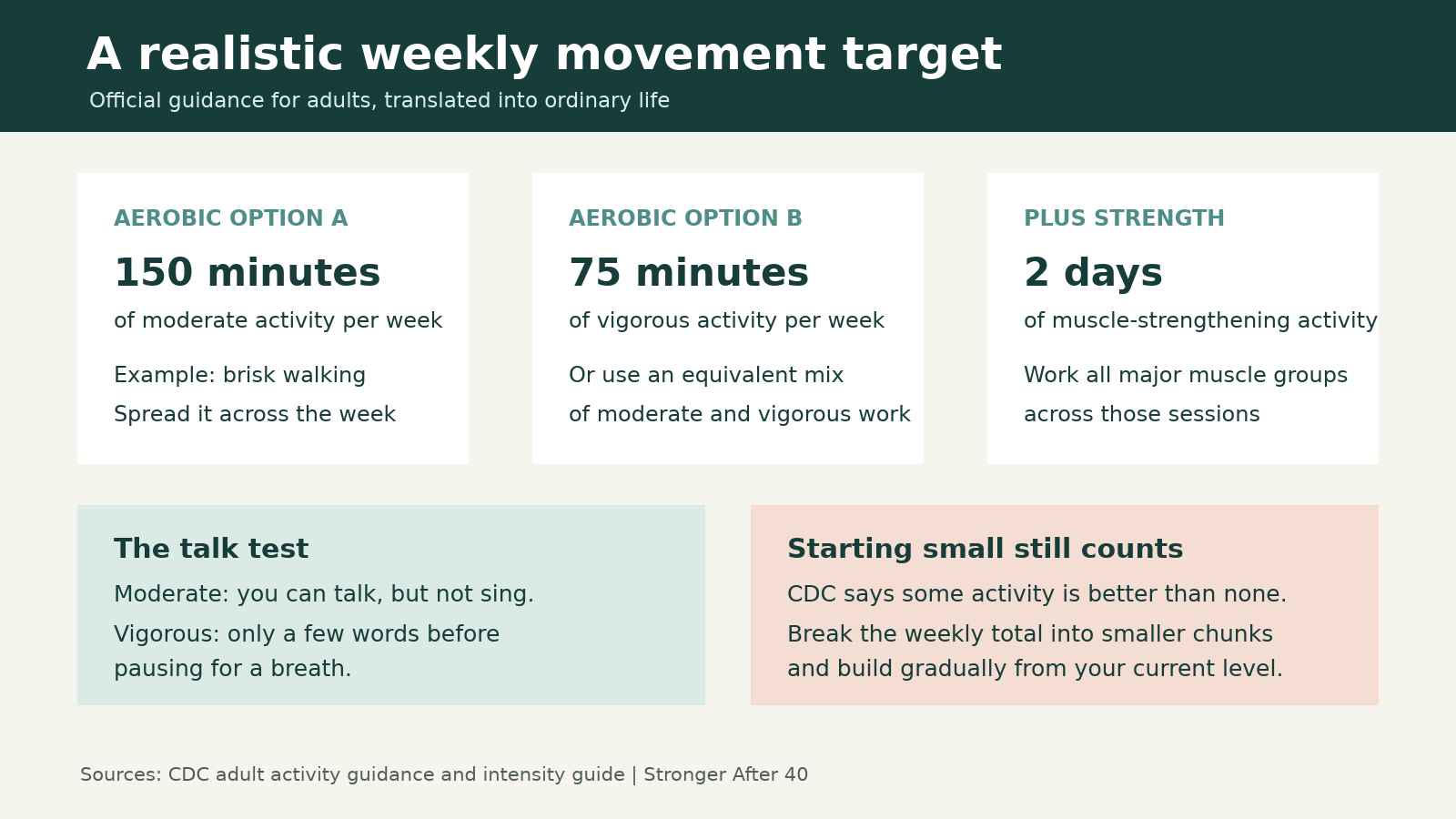
- Moderate intensity: You can talk, but you cannot sing.
- Vigorous intensity: You can say only a few words before pausing for a breath.
Brisk walking is the CDC’s example of moderate activity. But the same walk can feel light, moderate or vigorous depending on fitness, terrain, weather, mobility and health. The talk test makes the target more personal than a fixed speed on a treadmill.
The study gives us an association—not the reason behind it
The researchers cannot tell from this study why more active women reported fewer complaints decades later.
Physical activity supports physical and mental health more broadly, according to the CDC. But this particular analysis did not prove that exercise directly changed the brain, and it did not isolate a biological pathway.
It also cannot rule out every difference between women who were more active and those who were less active. Sleep, education, access to health care, diet, income, chronic illness and other habits can travel together over a lifetime. Researchers adjusted for a number of factors, but some residual confounding may remain.
That is not a reason to ignore the study. It is a reason to use it for what it is: another piece of evidence that midlife movement deserves a place in a healthy-aging plan.
What is a sensible target for exercise after 40?
The study itself does not prescribe a workout. For a practical target, official guidance is more useful.
The CDC recommends that adults work toward:
- 150 minutes of moderate-intensity aerobic activity each week, or
- 75 minutes of vigorous-intensity activity, or
- An equivalent mix of the two,
- Plus muscle-strengthening activity on at least two days each week, covering the major muscle groups.
Canadian guidance for adults ages 18–64 is similar: at least 150 minutes of moderate-to-vigorous aerobic activity weekly, major-muscle strengthening at least twice a week, and several hours of light activity.
Neither country says you have to complete the aerobic total in long, punishing sessions. CDC guidance allows it to be spread through the week and broken into smaller chunks.
How to make exercise after 40 easier to repeat
A plan for exercise after 40 does not need perfect motivation or a completely open calendar. It needs a shape that still works on an ordinary week—the kind with meetings, family responsibilities, poor weather and days when energy is limited. These five choices can make the official targets feel more workable without changing what those targets mean.
Give exercise after 40 two weekly anchors
Choose two time windows that are usually available and treat them as anchors rather than promises you must keep at any cost. One might be a Tuesday walk after lunch; another might be a short Saturday strength session. Once those anchors feel familiar, add time or another day. Starting with the whole 150-minute target can make a missed session feel like failure. Starting with two visible appointments gives you something concrete to repeat.
Keep a minimum version
Decide in advance what counts on a crowded day. Your minimum version of exercise after 40 might be a ten-minute walk, one round of familiar strength movements, or a few purposeful laps in the pool. The minimum is not the final goal. It is the version that keeps a disrupted week from turning into an abandoned month. When you have more time, do more; when you do not, keep the routine recognizable.
Measure effort instead of chasing someone else’s pace
The talk test is useful because it adjusts to the person doing the activity. A pace that feels moderate to one walker may feel light or vigorous to another. Rather than treating speed, distance or a fitness-device number as a verdict, notice whether you can talk but not sing. That gives your weekly minutes a consistent meaning while leaving room for different bodies, activities and starting points.
Put the plan where you can see it
A simple note can be more useful than a complicated tracker. Record the activity, approximate minutes, whether the effort felt light, moderate or vigorous, and whether you completed strength work that week. The purpose is not to produce a perfect score. It is to spot patterns: which time of day worked, which session kept getting squeezed out, and what adjustment would make next week more realistic.
Review the week without grading yourself
At the end of the week, ask what was easy to repeat and what created friction. If evening walks kept disappearing, move one to lunch. If a 30-minute block was hard to protect, try two shorter blocks. This kind of review turns exercise after 40 into a routine you can adjust, rather than a fixed plan you either pass or fail.
A realistic example week
Exercise after 40 does not need a complicated calendar. This example is an illustration, not a one-size-fits-all prescription, and each aerobic activity would need to feel moderate for you, using the talk test.
| Day | Example movement |
|---|---|
| Monday | 30-minute brisk walk |
| Tuesday | 25 minutes of moderate cycling, plus a short strength session |
| Wednesday | 20-minute brisk walk |
| Thursday | 20 minutes of moderate dancing, plus a short strength session |
| Friday | 30-minute brisk walk |
| Saturday | 25-minute moderate hike or another enjoyable activity |
| Sunday | Rest, gentle movement or an easy mobility session |
That example adds up to 150 minutes of moderate aerobic activity and includes strength work on two days.
The specific activities are replaceable. A pool session, an accessible seated routine, wheeling, recreational sport or another safe activity can fill the same role if it raises your effort appropriately. A sustainable routine should fit your body and your life—not resemble a fitness advertisement.
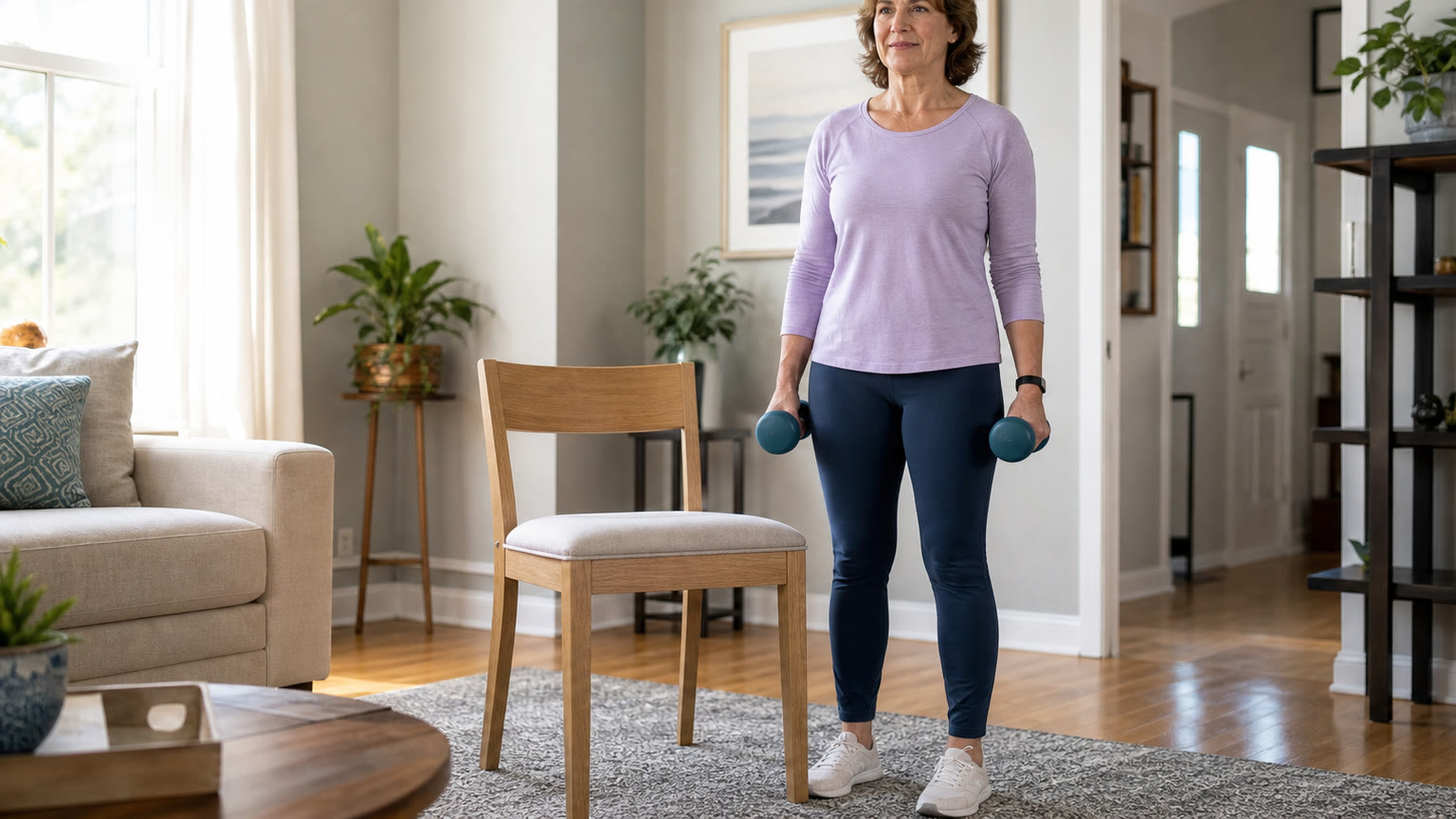
Adding strength work often raises another after-40 question: How much protein do you need after 40? Our separate guide explains the evidence and offers food-first examples.
If 150 minutes feels impossible, start below it
When exercise after 40 is new or you are returning after a long break, a weekly target can be useful without becoming a verdict on your current fitness.
CDC guidance is clear that some physical activity is better than none. Adults who sit less and do any amount of moderate or vigorous activity can gain some health benefits.
A more workable first step might be:
- A ten-minute walk after lunch on three days this week
- One short strength session using movements you already know how to do safely, with a plan to build toward two weekly sessions covering the major muscle groups
- Standing or moving during a regular phone call
- Choosing one enjoyable weekend activity instead of designing a “perfect” program
Once that feels routine, add time, another day or a little intensity—not all three at once.
If you have a medical condition, disability, significant pain or uncertainty about vigorous exercise, individualized guidance from a qualified health professional can help you choose an appropriate starting point.

What this study still cannot answer
The long follow-up is a strength, but several limitations matter:
- Activity was self-reported. Participants recalled activity during the previous year, which can introduce measurement error.
- It was not continuous tracking. The study did not objectively record how active each woman remained over the next three decades.
- The outcome was subjective. Cognitive complaints are not the same as a clinical diagnosis or an objective test of cognition.
- The participants were women. The result cannot automatically be generalized to every population.
- Association is not causation. More active women may have differed from less active women in ways the analysis could not fully capture.
- The study does not identify a perfect workout. It cannot tell us that one sport, pace or routine is best for long-term cognition.
These limitations do not erase the result. They put it in proportion.
The takeaway
Your 40s are not a deadline for brain health, and exercise is not a guarantee against dementia. But midlife is a meaningful time to build habits that support health across the decades.
This study’s most useful message is not “work out harder or else.” It is simpler:
Movement in midlife may matter later, and the routine you can repeat is more valuable than the plan you keep postponing.
If you are mostly inactive, start with a manageable amount. If you already walk, consider whether some of that time reaches moderate intensity. And if aerobic exercise is your main focus, remember the two weekly strength days recommended in both US and Canadian guidance.
For exercise after 40, the most useful plan is usually the one you can repeat. The future is never fully controllable, but today’s next walk may still be worth taking.
If you are also working on the food side of healthy aging, see Protein Isn’t the Whole Story After 40: 9 Vegetarian Pairings That Bring the Fiber Too.
Explore more evidence-led movement and wellbeing guidance in Healthy Aging.
Frequently asked questions
Does exercise after 40 prevent dementia?
No study can promise that. The new research found an association between greater self-reported midlife activity and lower odds of later subjective cognitive complaints. It did not prove that exercise prevents dementia or Alzheimer’s disease.
Is walking enough to count as moderate exercise?
It can be. CDC lists brisk walking as a moderate-intensity example. Use the talk test: at moderate intensity, you can talk but not sing. An easy stroll may fall into light activity instead, which can still be valuable.
Do I need exactly 150 minutes before exercise helps?
No. The 150-minute figure is a weekly target in public-health guidance, not a minimum threshold below which nothing counts. CDC says some activity is better than none, and smaller chunks can be spread through the week.
Does the study mean light housework is pointless?
No. Mild activity was not significantly associated with the study’s specific late-life outcome, but that does not prove light activity has no health value. The Canadian guidelines include several hours of light activity, including standing, as part of a healthy day.
Should women do strength training as well as walking?
Official US and Canadian guidelines recommend muscle-strengthening activity involving major muscle groups at least twice a week, in addition to aerobic movement. The new cognition study did not test a specific strength-training program.
More from Stronger After 40
- 15 High-Protein Vegetarian Meals for Adults Over 40—No Protein Powder Needed
- How Much Protein Do You Need After 40?
Sources and accuracy note
- Song et al.—Midlife physical activity and late-life subjective cognitive complaints in women
- Oxford Academic DOI record
- CDC adult physical activity guidance
- CDC guide to measuring physical activity intensity
- Canadian 24-Hour Movement Guidelines for Adults 18–64
This article was fact-checked against the primary study record and current official movement guidance on August 21, 2026. It distinguishes odds from risk, subjective cognitive complaints from dementia, and association from causation.