Walking for bone health after 40 is a useful start if walking is your main exercise. Do not stop. The problem is not walking. The problem is asking one activity to do every job.
Walking can support your heart, stamina, mood and ability to stay active. Brisk walking can also help you work toward the weekly aerobic-activity target recommended for adults. But when the goal is a more complete bone-health routine, walking is usually the base, not the entire plan.
The short answer: Keep walking. Add progressive muscle-strengthening exercise at least twice a week, and include balance or functional practice—especially as you get older. Impact exercise may help some people, but it is optional and should match your fracture risk, fitness and comfort.
Important: This article offers general education, not an osteoporosis treatment plan. If you have osteoporosis, a previous fragility fracture, unexplained pain, poor balance or a high risk of falling, ask a qualified health professional to tailor your exercise choices.
Walking for bone health after 40: why it matters
Walking is accessible, inexpensive and easy to repeat. It is also a weight-bearing activity: your legs support your body as you move against gravity.
That makes walking more relevant to bone health than non-weight-bearing activities such as swimming or stationary cycling. It also helps build the consistency that many complicated exercise plans never achieve. For a separate look at movement and healthy aging, read our evidence review of exercise after 40 and brain health.
For general health, the U.S. Centers for Disease Control and Prevention recommends that adults get at least 150 minutes of moderate-intensity aerobic activity each week, plus muscle-strengthening activity on at least two days. Brisk walking is one way to collect those aerobic minutes, and the activity can be divided into smaller blocks across the week.
So the question is not, “Does walking count?” It does.
What walking leaves out matters too.
What the bone research says about walking
Bone responds to the loads placed on it, but not every form of loading produces the same response at every part of the skeleton. Walking repeats a familiar, relatively modest load. That can be useful, but its effects on bone mineral density are not uniform.
A 2021 systematic review examined walking and Nordic-walking trials in perimenopausal and postmenopausal women. The researchers found low-certainty evidence and a site-specific pattern: walking did not clearly improve total-hip or femoral-neck bone density, although it showed a small lumbar-spine benefit compared with inactive controls.
That result needs careful interpretation:
- The studies involved women around and after menopause, not every adult over 40.
- The certainty of the evidence was low.
- Bone mineral density is an important measurement, but it is not the same as a proven reduction in fractures.
- Walking speed, duration, terrain and the participants’ starting fitness varied across studies.
This is why “walking builds strong bones” is too broad. But “walking does nothing for bones” is also wrong.
The honest takeaway: walking belongs in the plan, but walking alone may not provide the variety and progressive loading needed for a complete bone-health strategy.
The stronger plan: walk, strengthen and balance
The 2023 Canadian clinical guideline for osteoporosis and fracture prevention gives unusually clear practical advice. For postmenopausal women and men age 50 and older, it encourages activities such as walking for enjoyment and other benefits. But it says they should be done in addition to, not instead of, balance, functional and resistance training.
In practice, that means three things.
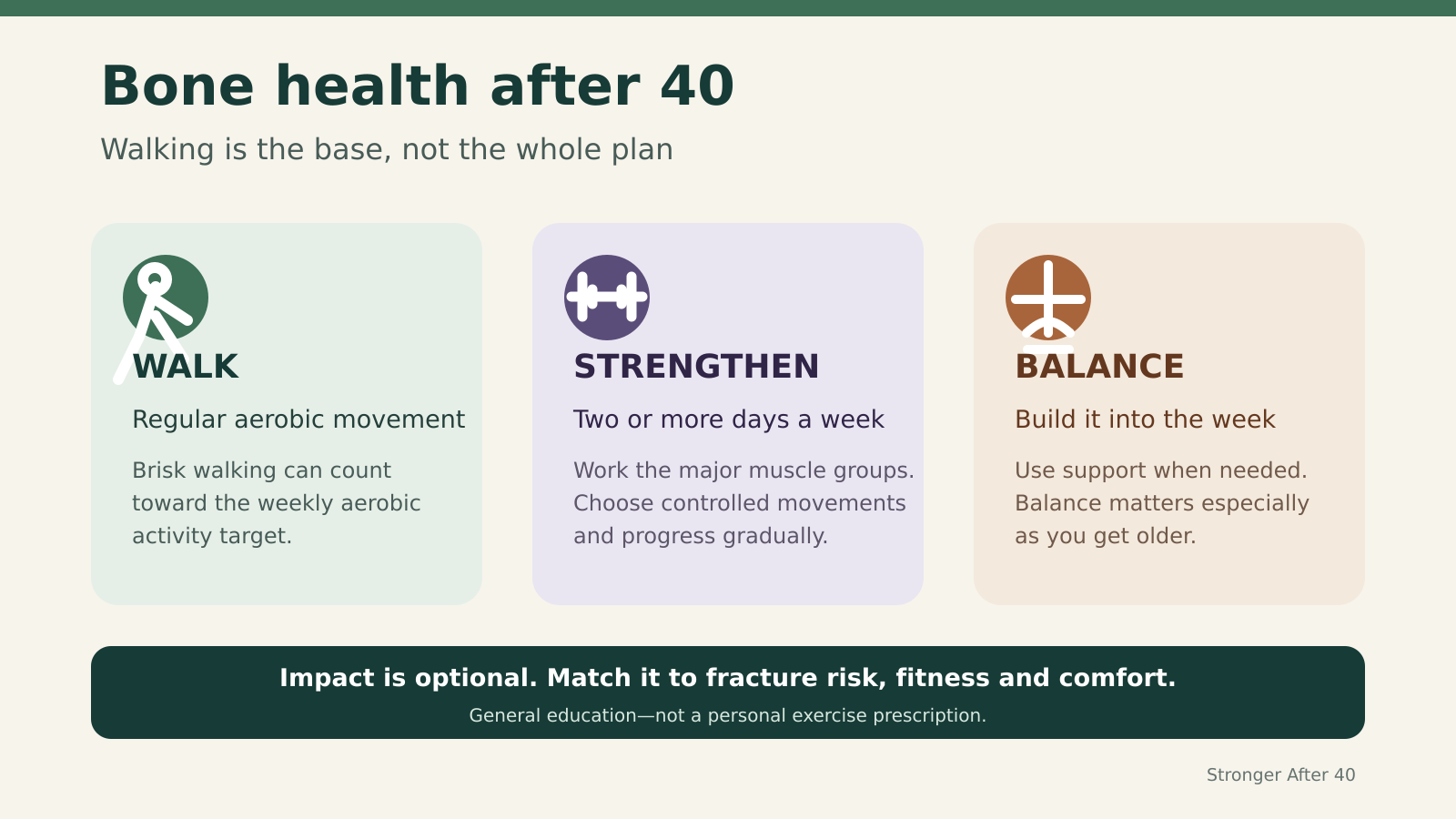
1. Keep walking as your aerobic base
Continue the walks you already enjoy. If your health and mobility allow, a brisk pace can help the activity count toward moderate-intensity aerobic exercise. A practical test is whether you can talk but would find singing difficult.
You can make walking more engaging without turning it into a punishing workout:
- Use different safe routes.
- Add gentle hills or stairs if they feel comfortable.
- Split a longer walk into shorter sessions.
- Walk with a friend or group for accountability.
- Increase time or pace gradually rather than changing everything at once.
None of these changes guarantees a gain in bone density. Their main job is to help you accumulate regular aerobic activity and maintain physical capacity.
2. Add progressive resistance training twice a week
Resistance training asks muscles to work against an external challenge: body weight, elastic bands, machines or free weights. “Progressive” means the challenge increases over time as you become stronger. It does not mean lifting the heaviest weight possible.
The Canadian guideline conditionally recommends progressive resistance exercise at least twice weekly for its target population. The CDC likewise recommends muscle-strengthening activity on two or more days for adults generally. If strength training has also made you reconsider your meals, our protein-after-40 guide explains how to estimate general daily needs.
A beginner session might draw from movements such as:
- Sit-to-stand from a stable chair or a controlled squat
- A resistance-band row
- A counter or wall push-up
- A bridge or another hip-strengthening movement
- A supported calf raise
- A low step-up, if balance and joints allow
Aim to work the major muscle groups rather than collecting dozens of exercises. The right resistance should feel challenging while still allowing controlled movement and steady breathing.
If you have never done resistance training, or if you have osteoporosis or a previous fracture, a physical therapist, kinesiologist or qualified trainer with osteoporosis experience can help choose safe movements and progression.
3. Practice balance and everyday function
Bone strength is only one part of fracture risk. Avoiding falls matters too.
For adults 65 and older, the CDC recommends weekly aerobic, muscle-strengthening and balance activity. The Canadian osteoporosis guideline strongly recommends balance and functional training at least twice weekly for postmenopausal women and men 50 and older in its scope.
Examples include:
- Practicing sit-to-stand from a chair
- Walking heel-to-toe beside a stable support
- Controlled side-stepping
- Gentle direction changes
- Supported single-leg standing
- Tai chi
Choose a level that challenges you without creating an unnecessary fall risk. Keep a counter, rail or sturdy chair within reach when needed.
What about impact exercise?
You may see advice to add hopping, jumping, jogging or a weighted vest because bones respond to impact. That idea should not become a universal prescription.
The Canadian guideline says moderate- or high-impact exercise should be added only when it is appropriate for the person’s fracture risk and physical fitness. Its safety and effectiveness are uncertain for people at high fracture risk.
That means impact work is an optional fourth layer, not a requirement for everyone.
Before experimenting with jumping or weighted walking, get individualized advice if you have:
- Diagnosed osteoporosis
- A previous spine, hip or other fragility fracture
- New or unexplained back, hip or joint pain
- Significant balance problems
- A recent fall
- A condition or medication that affects bone, balance or exercise tolerance
More load is not automatically better. Choose a level you can repeat safely and build on over time.
A simple weekly framework
This example translates the guidelines into an uncomplicated week. It is not a personalized prescription.
| Day | General activity |
|---|---|
| Monday | Brisk or comfortable walk + short full-body resistance session |
| Tuesday | Easy walk + brief supported balance practice |
| Wednesday | Walk or another enjoyable aerobic activity |
| Thursday | Second full-body resistance session |
| Friday | Walk + functional movements such as sit-to-stand or controlled step practice |
| Weekend | One enjoyable activity day and one easier recovery day, adjusted to your needs |
The walking sessions can be shorter or longer. Keep the pattern simple:
- Regular aerobic movement
- At least two muscle-strengthening days
- Repeated balance or functional practice
- Recovery that lets you stay consistent
For readers who are currently inactive, beginning with a few manageable sessions is more useful than chasing a perfect calendar and quitting after one week.
How to progress without overdoing it
Progress one variable at a time. For example, you might:
- Add a few minutes to one walk.
- Use a slightly firmer resistance band.
- Add a controlled repetition.
- Reduce hand support during a balance drill, only when safe.
- Move from a higher chair to a slightly lower one for sit-to-stand practice.
Give the new level time to feel familiar before adding another challenge.
If a movement causes pain or makes you feel unsteady, stop and get advice before repeating it.
People at high fracture risk may also need to modify repeated, loaded or end-range bending and twisting of the spine. This does not mean nobody should bend or rotate. It means movement choice and technique should be individualized rather than copied from a generic workout video.
When should you discuss bone screening?
Exercise helps, but it cannot tell you your bone density.
In the United States, the U.S. Preventive Services Task Force recommends osteoporosis screening for women age 65 and older. It also recommends screening postmenopausal women younger than 65 when clinical risk assessment shows increased fracture risk. For men, the task force says evidence is currently insufficient to determine the balance of benefits and harms of routine screening.
Those recommendations are not a diagnosis, and Canadian guidance differs in how fracture risk is assessed. If you have had a low-trauma fracture or have concerns about your personal risk, discuss them with your clinician rather than waiting for an exercise plan to answer the question.
Frequently asked questions
Is 30 minutes of walking a day enough for bone health?
Thirty minutes of brisk walking on five days can satisfy the CDC’s 150-minute weekly aerobic target. But aerobic minutes are only one part of the plan. Adults also need muscle-strengthening activity, and older adults benefit from balance work. Walking alone should not be treated as a complete osteoporosis-prevention or fracture-prevention program.
Is brisk walking better for bones than slow walking?
Brisk walking raises aerobic intensity and can help you meet general activity guidance. Bone-specific benefits are less predictable and depend on factors such as the person, skeletal site and training pattern. Do not assume that walking faster guarantees a measurable increase in bone density.
Are hills and stairs useful?
They can make a walk more demanding and help challenge the leg muscles. They still do not replace a progressive, full-body resistance program. Add them only when your joints, balance and surroundings make them safe.
Should I use a weighted vest while walking?
A weighted vest is not required for a bone-healthy routine. It changes both loading and balance, so it is not an automatic upgrade. If you have osteoporosis, a fracture history, pain or balance concerns, ask a qualified professional before using one.
How often should I strength train?
General U.S. adult guidance calls for muscle-strengthening activity on at least two days each week. The Canadian osteoporosis guideline also suggests progressive resistance training at least twice weekly for postmenopausal women and men 50 and older within its scope.
What if I already have osteoporosis?
Keep moving within the plan provided by your healthcare team, but do not rely on a generic article to select impact, resistance or spinal movements. An osteoporosis-trained physical therapist, kinesiologist or exercise professional can adapt exercises to your fracture risk, history and current ability.
The bottom line
Walking deserves to stay in your routine. It supports health, helps preserve the habit of movement and can form the aerobic base of an active week.
Just do not ask it to carry the whole bone-health plan.
A more complete approach after 40 is to walk regularly, strengthen major muscle groups at least twice a week, and practice balance or functional movements. Add impact only when it fits your health and fracture risk.
Start with one addition you can repeat. If you already walk, your next useful step may be two simple strength sessions while keeping the path you enjoy.
Sources and accuracy note
- Morin SN, et al. Clinical practice guideline for management of osteoporosis and fracture prevention in Canada: 2023 update
- Ma D, et al. Effects of walking on the preservation of bone mineral density in perimenopausal and postmenopausal women: a systematic review and meta-analysis
- CDC: Adult Activity—An Overview
- CDC: Older Adult Activity—An Overview
- CDC: How to Measure Physical Activity Intensity
- USPSTF: Osteoporosis to Prevent Fractures—Screening
- Osteoporosis Canada: Too Fit To Fracture
- Bone Health & Osteoporosis Foundation: Exercise for Your Bone Health
This article was fact-checked on August 24, 2026. It distinguishes general physical-activity guidance from evidence about bone mineral density and fracture prevention. The walking review involved perimenopausal and postmenopausal women and was rated low certainty; those limits are retained. The sample week is a general translation of U.S. and Canadian guidance, not a personalized medical prescription.
Explore more evidence-led guidance in Healthy Aging.