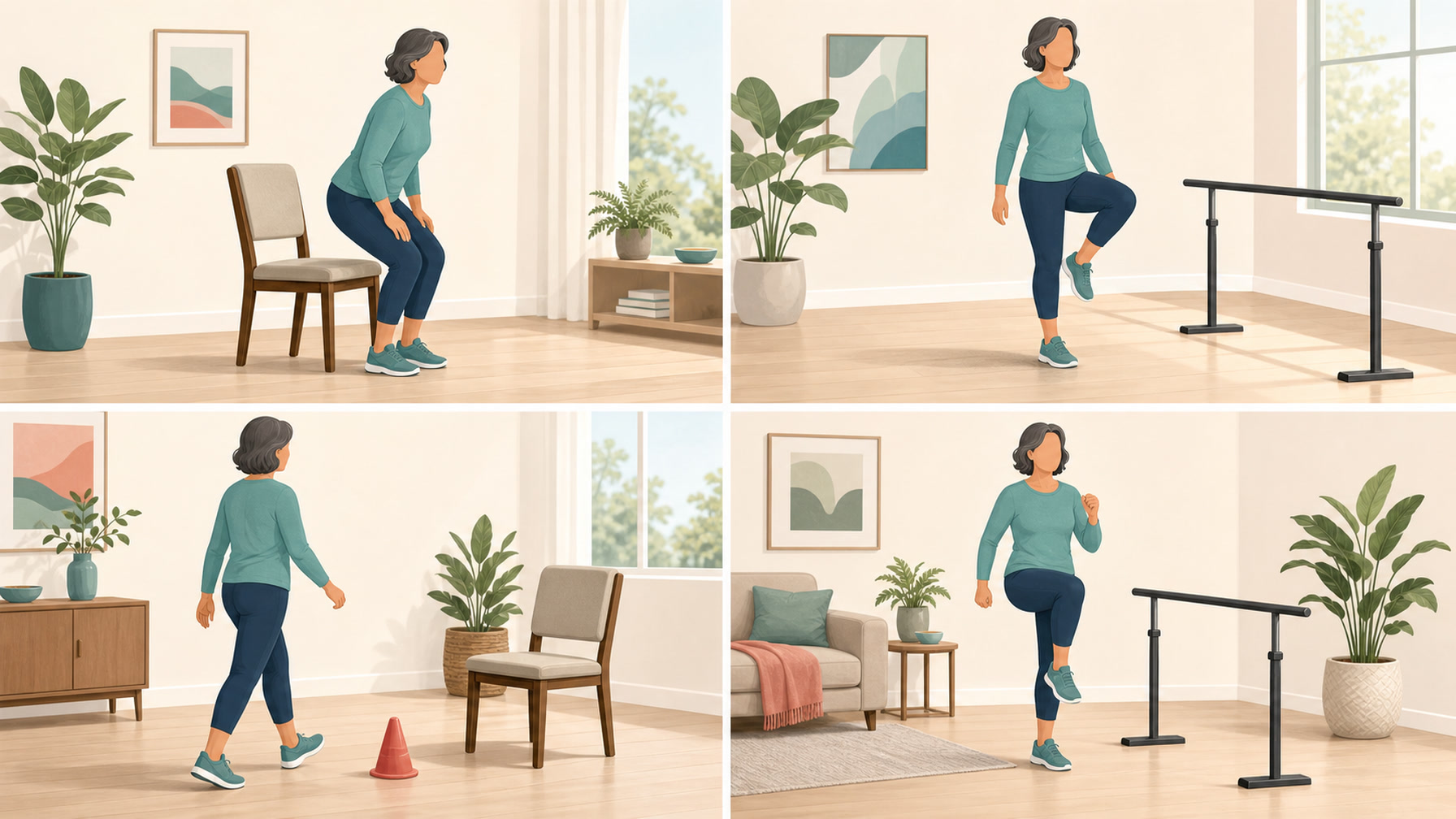
Mobility tests for healthy aging—such as chair stands, balance checks and walking tests—can reveal useful changes in function. They cannot calculate your biological age or predict how long you will live.
Set a timer. Stand up from a chair. Balance on one foot. Then comes the promise: your score reveals how well you are aging—or even how long you will live.
That last leap is where a useful fitness check turns into a shaky longevity claim.
Mobility tests can show how your legs, balance, endurance and coordination work together. Clinicians use standardized versions to help identify functional concerns and decide what deserves a closer look. But one score cannot diagnose a condition, capture every part of health or supply a personal expiration date.
A large study published in 2026 adds a timely reason to pay attention to functional fitness. It also shows why context matters.
What the new mobility study actually found
The study in JAMA Network Open followed 13,423 community-dwelling adults aged 65 and older in Taiwan. Their average age was 72.9, and 62.5% were women.
Participants completed seven assessments covering cardiorespiratory fitness, strength, flexibility, balance and agility. Researchers linked those results to health and death records over a median of seven years. During follow-up, 1,631 participants died.
Four assessments had especially strong associations with all-cause mortality when researchers compared the highest-performing fifth of participants with the lowest-performing fifth:
| Assessment | Main capacity | Adjusted hazard ratio, highest vs lowest group |
|---|---|---|
| 8-foot up-and-go | Balance and agility | 0.41 |
| One-leg stance | Balance | 0.50 |
| 30-second chair stand | Lower-body strength and endurance | 0.55 |
| 2-minute step test | Cardiorespiratory fitness | 0.58 |
A combined score across all seven assessments had an adjusted hazard ratio of 0.39.
Those numbers describe group-level associations during the study period. An adjusted hazard ratio cannot be read as an individual’s personal probability of dying, number of years remaining or risk erased by practicing one test.
The safest summary is simpler: in this cohort, people who performed better—particularly on measures of balance, agility, lower-body strength and endurance—also had lower mortality during follow-up after statistical adjustment.
Why this study is not a lifespan calculator
The research is useful, but several limits keep it from becoming a personal prediction tool.
It was observational
The study found associations; it did not prove that improving a test score extends life. Better performance may reflect many advantages that already affect health. The researchers adjusted for numerous factors, but unmeasured differences can remain, and reverse causation is possible: an underlying health problem could lower fitness before it is diagnosed.
It involved adults 65 and older in Taiwan
These results from community-dwelling Taiwanese adults 65 and older should not be converted into mortality cutoffs for someone in midlife in Chicago, Toronto or Vancouver. The sample also leaned toward healthier ambulatory adults able to complete the assessments, which further limits how broadly the results apply.
Fitness was measured once
A single session is a snapshot. Sleep, pain, illness, confidence and the testing setup can influence performance on a particular day. The study did not establish a home-testing schedule or prove that changing a score changes survival.
Function is only part of healthy aging
Strength and mobility matter, but so do heart health, cognition, hearing, vision, sleep, nutrition, social connection, medical care and the conditions a person is managing. A strong balance score cannot cancel every other risk, just as a poor score cannot define the whole person.
What four common mobility tests measure
These assessments overlap, but they are not interchangeable. Each asks a different question about function.
Safety first: If you already feel unsteady, have recently fallen, use a mobility aid or are unsure whether a test is appropriate, skip the unsupervised challenge and ask a clinician or physical therapist about a supervised assessment.
1. The 30-second chair stand: leg strength and endurance
In a standardized chair-stand assessment, a person repeatedly rises to a full stand and sits during a set period. The CDC’s STEADI clinical resources describe the 30-second version as a way for healthcare providers to assess leg strength and endurance.
That makes intuitive sense: getting out of a chair asks the hips and legs to produce force while the trunk stays controlled. It resembles a task most of us perform throughout the day.
What it does not tell you is why standing feels difficult. Pain, technique, chair height, fatigue and other health factors can affect performance. A number found in a social-media post may also come from a different protocol or age group.
If standing from an ordinary chair has become noticeably harder, especially if the change persists, that observation is more useful as a reason to investigate than as a verdict on “biological age.”
2. The one-leg stance: balance under a narrow base of support
Standing on one foot reduces the base supporting your body, so the task challenges balance. In the Taiwanese cohort, one-leg stance performance was strongly associated with mortality at the group level.
That finding does not turn a kitchen balance attempt into a longevity test. A wobble does not identify its cause, and an online time target is not automatically valid for every age or health situation.
Anyone who can safely practice balance should do so near a stable support and on a clear, level surface—not on a cushion, stool or other unstable object. If balance has worsened or you are worried about falling, professional assessment is safer than repeatedly testing your limit alone.
3. Up-and-go tests: standing, walking, turning and sitting
Up-and-go assessments combine several abilities in one short sequence: rising from a chair, walking, turning, returning and sitting with control.
Here, terminology matters. The 2026 study used an 8-foot up-and-go. The CDC’s clinical Timed Up and Go, often called TUG, uses a distance of 10 feet, or 3 meters. They assess related aspects of mobility, but they are not the same protocol, and their scores should not be swapped.
A slower result may show that some part of the sequence deserves attention. The test alone cannot tell you whether the limiting factor is strength, balance, pain, confidence, coordination or another issue. That is why clinical context matters more than a stopwatch by itself.
4. The 2-minute step test: cardiorespiratory endurance
For the study’s 2-minute step test, participants stepped in place for two minutes. Unlike a quiet balance check, this is an endurance task: it asks the heart, lungs and working muscles to support repeated movement.
The test was associated with mortality in the study cohort, but the paper did not validate a universal home target for adults over 40. If you are not accustomed to exertion, have a chronic condition that affects activity or develop concerning symptoms during movement, ask a healthcare professional what type and amount of activity fits you.
You do not need a two-minute score to begin improving endurance. Walking, cycling, swimming and other activities that match your abilities can all contribute to aerobic fitness.
What a mobility score cannot tell you
A score can answer a narrow question about performance under specific conditions. It cannot, by itself, tell you:
- your “true” biological age;
- how many years you will live;
- whether you have a particular disease;
- why your performance changed;
- whether a cutoff developed for another population applies to you;
- whether strength, balance, mobility or endurance is the only capacity you need to train.
A test validated in one group cannot simply inherit the meaning of another test.
How to use mobility tests for healthy aging after 40
You do not need to wait until 65 to care about the capacities measured in the study. Its mortality results came from community-dwelling Taiwanese adults 65 and older, so they cannot be applied directly to adults in their 40s and 50s. Strength, balance, mobility and endurance still support ordinary life: carrying groceries, climbing stairs, getting up from the floor and recovering from a stumble.
The practical goal is not to become excellent at a test. It is to build the underlying capacity.
Train lower-body strength
Chair stands can be an exercise as well as an assessment when they are appropriate for you. Other options include supported squats, low step-ups and resistance exercises selected for your current ability. The CDC recommends muscle-strengthening activity on at least two days each week for adults.
If you are also thinking about bone strength, see our guide to whether walking is enough for bone health after 40.
Include balance and coordination
Balance practice can be simple: controlled weight shifts, heel-to-toe walking near support or a supported single-leg stance. Adults 65 and older are specifically advised by the CDC to include balance activities each week alongside aerobic and strengthening work.
The point is not to flirt with a fall. Use a stable support, clear the floor and choose a challenge you can control.
Build aerobic capacity
Current CDC guidance recommends at least 150 minutes of moderate-intensity aerobic activity per week, or 75 minutes of vigorous activity or an equivalent combination. That sits alongside muscle-strengthening activity on at least two days each week. Activity can be divided across the week, and some is better than none.
Walking is one accessible option. Cycling, water exercise and other rhythmic activities may suit different joints, preferences and fitness levels. Start slowly and progress rather than trying to prove yourself in one hard session.
Keep the whole picture in view
The new study measured several domains, and the combined fitness index showed a stronger association than any one score. That does not make the composite a DIY longevity calculator; it reinforces a broader lesson. Healthy aging is not one trick.
A week that includes aerobic movement, strength and balance is more useful than repeatedly rehearsing one viral challenge. Regular movement may support more than mobility, too; read what a long-term study of women found about exercise in the 40s and later brain health.
When a change deserves professional attention
A poor test result is not a diagnosis. It can be a clue.
Consider discussing mobility with a healthcare professional if you:
- have fallen recently or are increasingly worried about falling;
- notice worsening unsteadiness or a clear decline in everyday function;
- become dizzy, unusually winded or painful during a test or ordinary activity;
- need a mobility aid or feel unsafe attempting a task alone;
- have a chronic condition and are unsure how to exercise safely.
A clinician or physical therapist can look beyond the final number—at movement quality, symptoms, medications, strength, balance and the rest of your health—and help decide what comes next.
The takeaway: use mobility tests as clues, not verdicts
Chair stands, balance checks, up-and-go assessments and step tests can reveal useful information about function. A 2026 study found that better performance was associated with lower mortality among community-dwelling Taiwanese adults 65 and older, but it did not create a lifespan calculator for everyone over 40.
Pay attention to what daily movement is telling you. Build strength, balance and endurance in ways that fit your body. If a change concerns you, bring the clue to someone who can evaluate the full picture.
A stopwatch can measure a task. It cannot measure your worth—or write the rest of your life.
Frequently asked questions
Can a chair-stand test predict how long I will live?
No. The 2026 study found a group-level association between chair-stand performance and mortality among community-dwelling adults 65 and older in Taiwan. It did not show that a chair-stand score can predict an individual lifespan or that practicing the test will extend life.
What is a good chair-stand or balance score for my age?
There is no universal score that applies across every protocol, age group and health context. The chair used, instructions, timing and population all matter. Use a validated clinical assessment if you need interpretation rather than borrowing a cutoff from a viral post.
Do these findings apply to people in their 40s and 50s?
Not directly. The study included community-dwelling adults aged 65 and older in Taiwan. Adults in midlife can still benefit from supporting strength, balance, mobility and aerobic fitness, but the study’s mortality comparisons should not be used to estimate risk for a younger person.
Is it safe to perform these mobility tests at home?
Not for everyone. If you feel unsteady, have fallen, use a mobility aid or have a condition that affects safe movement, ask for a supervised assessment. If you do practice an appropriate balance or chair exercise, use a stable surface and keep the area clear.
Which mobility test is the most important?
No single test captures the full picture. The study measured several domains, including flexibility, while balance/agility, lower-body strength and cardiorespiratory fitness showed the strongest individual associations. The combined index had the strongest overall association. The better question is which capacity you may need to support—not which test can label your future.
Sources
- Wu M, Hsu C, Hsu H, et al. Physical Fitness and All-Cause Mortality in Older Adults. JAMA Network Open. Published August 10, 2026.
- Centers for Disease Control and Prevention. STEADI Clinical Resources and Functional Assessments.
- Centers for Disease Control and Prevention. Adult Activity: An Overview.
- Centers for Disease Control and Prevention. Older Adult Activity: An Overview.
- Associated Press. Mobility tests can tell doctors a lot about how you’re aging, but there are many other factors. Updated August 22, 2026.
- News-Medical. These simple fitness tests revealed which older adults had the lowest death risk. Published August 24, 2026.
Accuracy note: This article distinguishes observational associations from causation and preserves the study’s age, geography and population limits. The JAMA full-text funding and conflict disclosures could not be independently inspected because the publisher blocked automated access, so this article makes no claim about them. Information is educational and does not replace individualized medical advice.
Explore more evidence-led guidance in Healthy Aging.