Reading time: 7 minutes
Healthy aging does not have to begin with a new device, complicated tracking plan, or costly supplement stack. A survey of 63 health experts helps explain why.
A new survey from U.S. News & World Report — its second annual Healthy Aging Survey, summarized in a fact-checked report from Everyday Health — asked a multidisciplinary panel of doctors, registered dietitians, fitness professionals, pharmacists, and researchers what supports healthy aging.
Their answers were refreshingly basic. And for anyone over 40 who’s tired of being told they need to “hack” their way to a longer life, surprisingly reassuring.
The survey at a glance
The 2026 Healthy Aging Survey polled 63 health experts across disciplines. It coincides with September being Healthy Aging Month, making its practical message especially timely.
The panel included medical doctors, registered dietitians, fitness professionals, pharmacists, and researchers. They were asked to rank important factors for healthy aging and weigh in on current wellness trends.
The results won’t trend on social media. They’re too boring for that. But they might actually help.
The top 3: diet, exercise, sleep
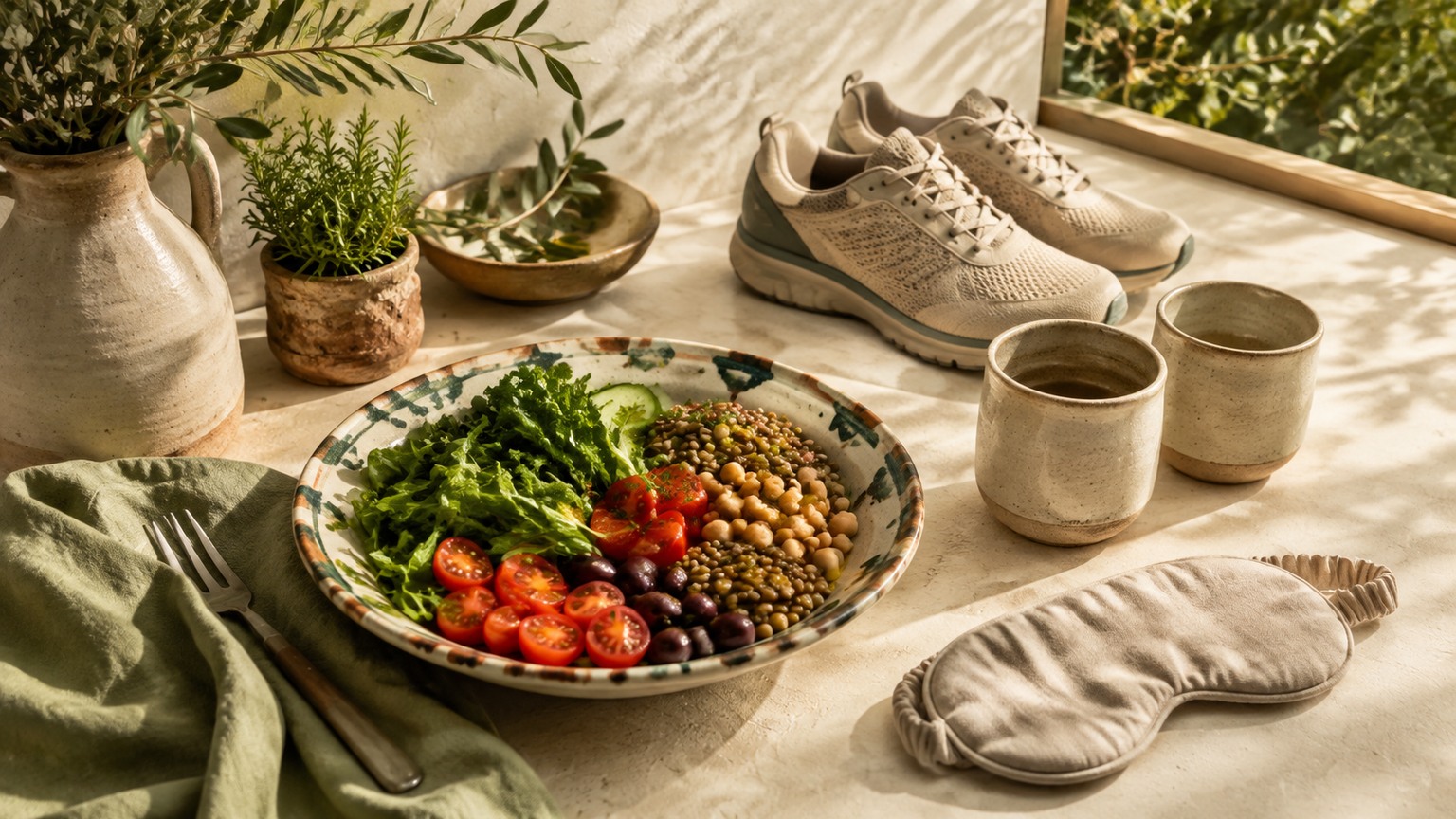
When asked to rank the most important factors for healthy aging, two habits tied at the top: 89% of experts ranked a nutrient-dense, well-balanced diet and regular physical activity as equally important.
Food and movement came first.
Restorative, high-quality sleep rounded out the top three, with 30% of respondents ranking it as a crucial healthy aging habit.
“We’re surrounded by messages telling us that we need to hack, track, and optimize our way to a longer life,” says Bonnie Taub-Dix, RDN, director of BTD Nutrition Consultants, who participated in the survey. “Yet the habits that rose to the top are remarkably basic, and to some, boring.”
The survey did not test whether particular biohacking tools work. It did show that these experts placed familiar daily habits at the foundation of healthy aging.
If you’re looking for practical ways to build that foundation, our guides on exercise and brain health after 40 and walking for bone health offer evidence-led starting points.
The “inflammaging” connection
Nearly half of the experts — 48% — said an anti-inflammatory diet, such as the Mediterranean diet, is the best way to manage “inflammaging,” a term used for chronic, low-grade inflammation associated with aging.
That percentage describes what the survey panel prioritized; it does not prove that a particular eating pattern slows or reverses biological aging. The practical point is to focus on the overall quality of your usual eating pattern rather than expecting one “anti-inflammatory” product to do the work.
For a deeper look at how diet quality connects to biological aging after 40, see our article on diet quality and biological age.
The blind spot no one talks about
Here’s where the survey gets interesting. 59% of experts listed social isolation as the most underappreciated potential accelerator of biological aging.
The finding matters because social connection is easy to leave out of conversations dominated by food, exercise, products, and measurements.
“We tend to mostly think about longevity in terms of what we eat, how much we exercise, or what products we use on our bodies,” Taub-Dix says. “But having people in our lives who make us feel connected, valued, and supported matters more than you may realize.”
In 2023, then-U.S. Surgeon General Vivek Murthy, MD, put a public spotlight on the “healing effects” of social connection and community.
“Sharing a meal, taking a walk with a friend, or simply having someone you can call is good for your emotional health and may support physical health as well,” Taub-Dix adds.
Damian Folch, MD, a family medicine doctor affiliated with Tufts Medicine Lowell General Hospital in Massachusetts, puts it more simply: staying socially connected “keeps your mind active and your heart happy.”
The takeaway isn’t that you need a dozen close friends. It’s that the quality of your relationships after 40 may matter more for healthy aging than the contents of your supplement cabinet.
The supplement answer needs context
The survey asked panelists to recommend one supplement or vitamin to support healthy aging. The top choice was a multivitamin (35%), followed by vitamin D (22%), which the report noted can be difficult to get from food alone.
But here’s the context that matters: experts didn’t list supplements as an important part of wellness overall. Those percentages came from a question asking panelists to recommend one supplement; they do not mean supplements outranked food, movement, sleep, or connection.
“The basics work and, more importantly, they’re things we can actually sustain,” Taub-Dix says. “Moreover, these habits don’t have to cost a lot of money, if they require any expense at all.”
That’s not a slogan. It’s a strategy.
Frequently asked questions
What is the 2026 Healthy Aging Survey?
It is the second annual survey from U.S. News & World Report. The 2026 edition gathered opinions from 63 health experts, including doctors, registered dietitians, fitness professionals, pharmacists, and researchers.
Which habits did experts rank most highly?
A nutrient-dense, well-balanced diet and regular physical activity tied at the top, with 89% of experts selecting each. High-quality sleep rounded out the top three, with 30% ranking it as crucial.
Did the survey prove that biohacks do not work?
No. It was an expert survey, not a clinical trial comparing biohacks with lifestyle habits. It shows what the participating experts prioritized, not which intervention will extend an individual’s life.
Fifty-nine percent of respondents listed social isolation as the most underappreciated potential accelerator of biological aging. That makes connection an important part of the conversation, alongside food, movement, and sleep.
Did experts recommend supplements?
When asked to recommend one supplement or vitamin, 35% selected a multivitamin and 22% selected vitamin D. Supplements were not ranked among the survey’s leading overall wellness priorities, so those answers need that context.
The bottom line
The survey is useful not because it discovered a new longevity secret, but because it clarifies priorities.
After 40, the pressure to optimize — to track every biomarker, buy every device, try every protocol — can become its own source of stress. This survey offers permission to step back. To eat a balanced diet. To move your body regularly. To sleep well. To call a friend.
The basics may sound boring because they are familiar. The participating experts prioritized them ahead of biohacks, but the survey did not test whether any intervention extends life.
This article is for general informational purposes only and does not constitute medical advice. Consult a qualified healthcare provider for advice tailored to your health, medications, diet, exercise routine, or supplement use.
Sources
- Everyday Health. Korin Miller. “Here Are the Top Strategies for Healthy Aging, According to 63 Experts.” September 1, 2026. Fact-checked by Tom Gavin.
- MSN / Sacramento Bee. Vince Basada. “What are the best tips in order to age well? What latest US News survey shows.” September 2, 2026.