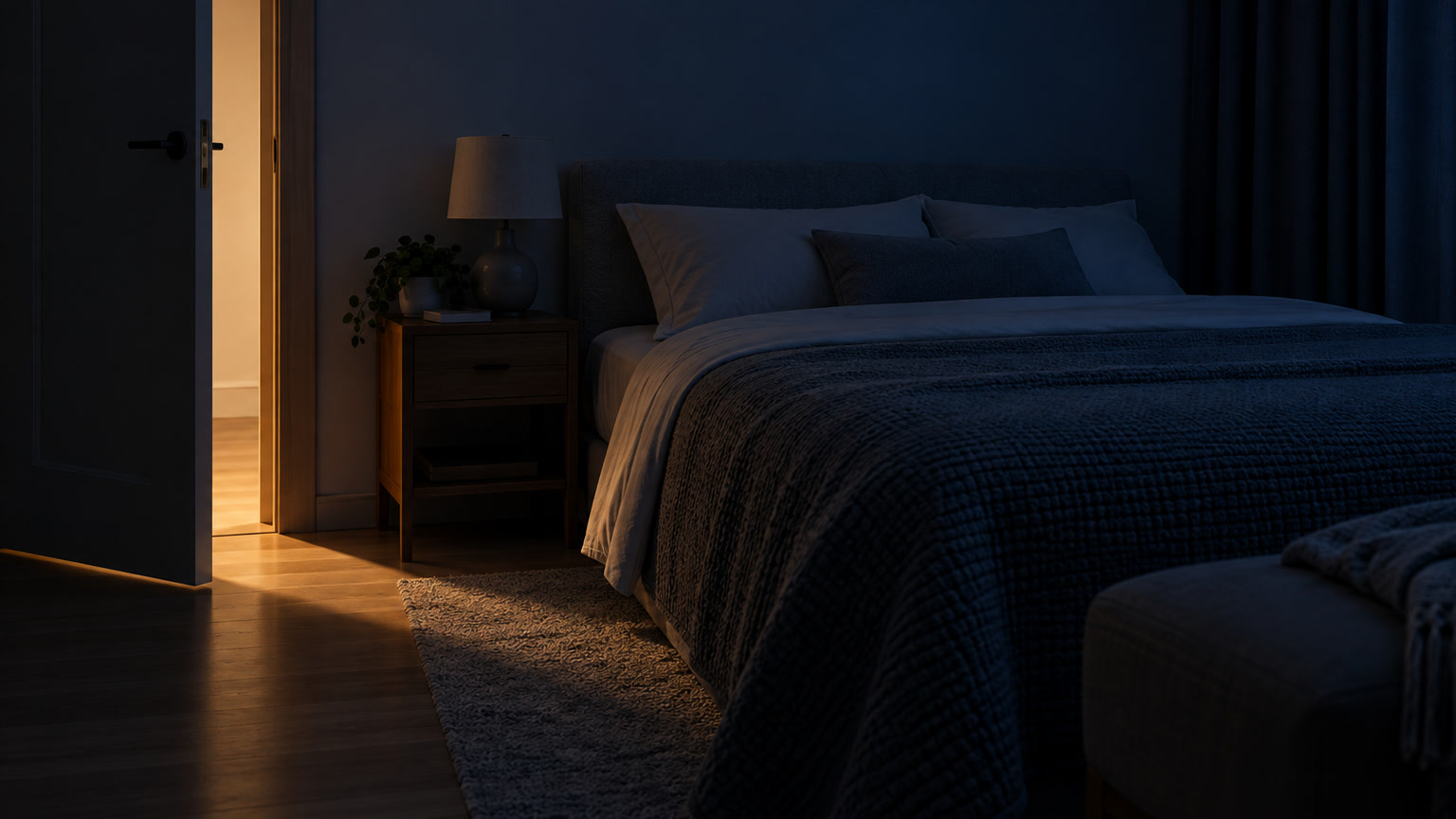
That strip of light under the bedroom door may seem too faint to matter. A new study does not prove that it harms your heart, but it adds to a growing body of evidence that our bodies notice nighttime light—even when we sleep through it.
Researchers studying UK Biobank participants found that higher light exposure at night was associated with subtle differences in heart structure and function on MRI. In a larger analysis, it was also linked with higher relative risks of several cardiovascular conditions over time.
The useful takeaway is not “fear every night-light.” It is simpler: make your sleeping space as dark as is practical without compromising safety.
The short answer
Sleeping with the lights on has been linked to less favorable heart measures, but researchers have not shown that bedroom light directly causes heart disease.
The new study is notable because it used wearable light measurements rather than asking people to remember how bright their rooms were. It also looked at detailed heart scans and longer-term health records. Still, it was observational, and a wrist sensor cannot tell researchers whether the light came from a lamp, television, phone, hallway, streetlight, or workplace.
What to remember:
- The main heart-scan analysis included 11,071 UK Biobank participants.
- Light was measured at the wrist for seven days, not continuously for years.
- Cardiac MRI scans were performed about three years later.
- Higher nighttime light was associated with modest, mostly subclinical heart differences.
- A separate outcomes analysis found higher relative cardiovascular risks, but it did not provide the absolute risk for an individual reader.
- Association is not causation.
- A dim night-light may still be appropriate when it is needed for safe movement.
What the new heart study measured
The study, published in the European Heart Journal on September 9, 2026, analyzed data from people who wore a wrist accelerometer with a built-in light sensor for one week between 2013 and 2015.
Researchers estimated nighttime exposure exceeding 3 lux. About three years later, 11,071 participants had cardiovascular magnetic resonance imaging, commonly called cardiac MRI. These scans allowed the research team to examine the size, shape, and function of different heart chambers in far more detail than a routine questionnaire could provide.
After accounting for multiple variables, the high-exposure group was more likely than the no-exposure group to show:
- a 2.4% higher measure of left-ventricular muscle mass, adjusted for height;
- 1.5% greater average wall thickness; and
- a 1.9% lower myocardial contraction fraction, a measurement related to how the heart muscle contracts.
The researchers also reported differences involving strain measurements, the right ventricle, and the left atrium. These were imaging findings, not a declaration that every person in the higher-light group had symptomatic heart disease.
That distinction matters. A percentage difference in a research measurement is not the same as a diagnosis, and it cannot tell you what happened in any one participant.
The larger outcomes analysis deserves caution, too
The researchers separately examined cardiovascular outcomes and mortality among 73,286 UK Biobank participants over roughly 8 to 10 years.
Compared with the no-exposure group, the high-nighttime-light group had higher relative risks of:
- heart failure: 29%;
- atrial fibrillation: 15%;
- myocardial infarction: 24%;
- stroke: 33%; and
- cardiovascular mortality: 26%.
Those numbers sound dramatic, but they are relative risks. The accessible study abstract does not provide the absolute risk in each group. A 29% relative increase does not mean that 29 out of every 100 exposed people developed heart failure, nor does it predict your personal risk.
The study also cannot prove that light was the reason these outcomes occurred. Nighttime light could travel alongside other factors—such as disrupted schedules, shorter sleep, illness, caregiving duties, shift work, or environmental conditions—that are difficult to separate completely in an observational study.
This was personal light exposure, not a bedroom-light test
It is tempting to turn the 3-lux threshold into a list of “safe” and “unsafe” lamps. The research does not support that.
A lux is a measure of the light reaching a surface. In this study, that surface was effectively the participant’s wrist sensor—not the eyes and not a fixed point beside the bed. The reading would change with distance, direction, bedding, body position, and the location of the light source.
A Tulane University explanation of the study described more than 3 lux as roughly comparable to a low-brightness phone on a nightstand or hallway light entering through a partly open door. Treat those as illustrations, not universal conversions. Your phone, lamp, hallway, and room layout may produce very different exposure.
The university release also lists the heart-scan sample as 11,017. The peer-reviewed abstract reports 11,071, so that is the figure used here.
Why might light at night affect the body?
Light is one of the signals that helps synchronize the body’s circadian system—its network of roughly 24-hour rhythms. A 2025 American Heart Association scientific statement identifies light exposure, sleep timing, meals, and physical activity as important timing cues. It discusses bright light in the morning and avoiding light at night as ways to support circadian health.
Sleep may be part of the connection. In the 2026 study, shorter sleep duration statistically accounted for part of many observed associations—an estimated 24% to 49%. That does not prove a chain in which light reduced sleep and reduced sleep changed the heart. It means sleep duration explained some of the relationship in the researchers’ model.
A much smaller laboratory experiment offers another clue. In a 2022 PNAS study, 20 healthy adults ages 18 to 40 were assigned to two dim nights or to one dim night followed by a night with 100 lux of room light. After the brighter night, researchers observed a higher nighttime heart rate and greater insulin resistance the next morning.
That experiment shows that the body can respond quickly to light during sleep. It does not show that one bright night causes lasting heart changes, and its young, healthy participants do not represent everyone over 40. The 100-lux condition was also far brighter than the 3-lux threshold used in the newer observational analysis.
Earlier research found a similar association in adults over 40
The new heart-scan paper does not stand entirely alone. A 2025 JAMA Network Open study followed 88,905 UK Biobank participants older than 40, with a mean age of 62.4. They also wore wrist light sensors for one week.
Over 9.5 years, participants with the brightest nights had higher relative risks of coronary artery disease, heart attack, heart failure, atrial fibrillation, and stroke than those with darker nights, even after the researchers adjusted for established cardiovascular risk factors.
The authors were clear about the study’s weaknesses. The cohort was predominantly White and healthier and more advantaged than the general population. Light was measured during one week, the sources of that light were unknown, and the observational design could not establish cause and effect.
Two large cohorts pointing in the same direction make nighttime light worth studying. They still do not turn an association into a treatment recommendation.
How to make your bedroom darker without creating a fall risk
You do not need to chase perfect darkness or buy a light meter. Start with obvious sources and protect your ability to move safely.
1. Darken the room when you are actually ready to sleep
Turn off overhead lights and bedside lamps. Draw curtains or shades if outdoor lighting reaches the bed. If a television is part of your bedtime routine, use a timer so it does not remain on after you fall asleep.
The National Heart, Lung, and Blood Institute advises avoiding bright artificial light from televisions and computer screens before bed and keeping the bedroom quiet, cool, and dark.
2. Reduce unnecessary screen glow
Silence nonessential alerts, place the phone face down, and keep it far enough from the bed that an incoming notification does not light the room near your face. These steps are practical ways to reduce disruption; the heart studies did not test any specific phone setting.
3. Consider an eye mask for comfort—not as heart treatment
An eye mask may make a bright room feel darker and is one option mentioned in Tulane’s practical summary. However, the study did not test whether masks change cardiac MRI findings or prevent cardiovascular events. Use one only if it feels comfortable and suits your situation.
4. Keep safe lighting available when you get up
A darker bedroom should never mean walking blindly to the bathroom. NHLBI notes that a dim night-light is fine if needed. The Centers for Disease Control and Prevention advises good lighting in rooms and hallways, with accessible switches or motion-sensor lights, as part of fall prevention for older adults.
A reasonable compromise is darkness while you are in bed, paired with targeted light that comes on when you need to stand or walk. Use enough light to see obstacles and changes in floor level clearly. If you have impaired vision, balance problems, dizziness, or a history of falls, immediate safety takes priority over minimizing every trace of light.
5. Do not let one bedroom habit overshadow the bigger picture
Nighttime light is one possible, modifiable exposure—not a verdict on your heart health. A dark room cannot replace medical care or established cardiovascular prevention. If light is unavoidable because of shift work, caregiving, anxiety, or a health need, focus on realistic improvements rather than perfection.
For a broader view of habits that support well-being over time, see why healthy-aging experts say the basics beat biohacks. If menopause-related night sweats are already disrupting sleep, our guide to night sweats and sleep after 40 offers additional practical steps.
What the findings mean after 40
The strongest reason to pay attention is not that researchers proved a bedside lamp causes heart disease. They did not. It is that a detailed new heart-imaging study now sits beside an earlier large cohort and a small controlled experiment, all suggesting that the body may not treat nighttime light as neutral.
For most people, reducing unnecessary light is a low-burden sleep-environment change. Turn off what you do not need, block intrusive outdoor light when practical, and keep safe pathway lighting available.
That is a measured response to the evidence: darker nights where possible, safe movement always, and no promises that one change will prevent a cardiovascular event.
Frequently asked questions
Is sleeping with the lights on bad for your heart?
Research has found associations between nighttime light exposure and less favorable heart measurements or higher cardiovascular-event rates. It has not proved that sleeping with a light on directly causes heart disease.
Is a dim night-light safe to use?
NHLBI says a dim night-light is fine if needed. For anyone at risk of falling, enough light to move safely is more important than pursuing total darkness. An accessible switch or motion-sensor pathway light may help balance both needs.
Does falling asleep with the television on count as nighttime light?
A television produces artificial light, and NHLBI advises avoiding bright television and computer light before bed. However, the new study used wrist sensors and did not identify which devices produced each participant’s exposure, so it cannot isolate television use specifically.
Is 3 lux bright?
Three lux is dim, but a lux reading depends on where and how it is measured. The study measured at the wrist. A lamp, phone, or hallway light cannot be assigned a universal lux value without measuring the actual setup.
Will an eye mask protect my heart?
That has not been shown. An eye mask may reduce perceived light and make sleep more comfortable, but the study did not test whether it prevents heart changes or cardiovascular events.
Sources
- Dai J, Dai W, Heianza Y, Qi L. Nighttime light exposure and cardiac structure and function. European Heart Journal. Published September 9, 2026. PubMed record.
- Windred DP, Burns AC, Rutter MK, et al. Light Exposure at Night and Cardiovascular Disease Incidence. JAMA Network Open. 2025. Open full text.
- Mason IC, Grimaldi D, Reid KJ, et al. Light exposure during sleep impairs cardiometabolic function. PNAS. 2022. Open full text.
- American Heart Association. Role of Circadian Health in Cardiometabolic Health and Disease Risk. Circulation. 2025.
- National Heart, Lung, and Blood Institute. Healthy Sleep Habits.
- Centers for Disease Control and Prevention. About Vision Impairment and Falls Among Older Adults.
- Tulane University. Study: Even low levels of nighttime light exposure may weaken the heart.
- National Institute of Standards and Technology. SP 330 — The International System of Units, Section 2.
This article is for general educational purposes and is not a substitute for individualized medical advice. Do not remove lighting needed for safe mobility or medical care.